1. Free Consultation
A provider reviews your history, explains the science, and answers every question — by phone or in person. No referral needed for most patients.
No mystery, no surprises — here is your path from first phone call to lasting relief.
Step by Step
During a Session
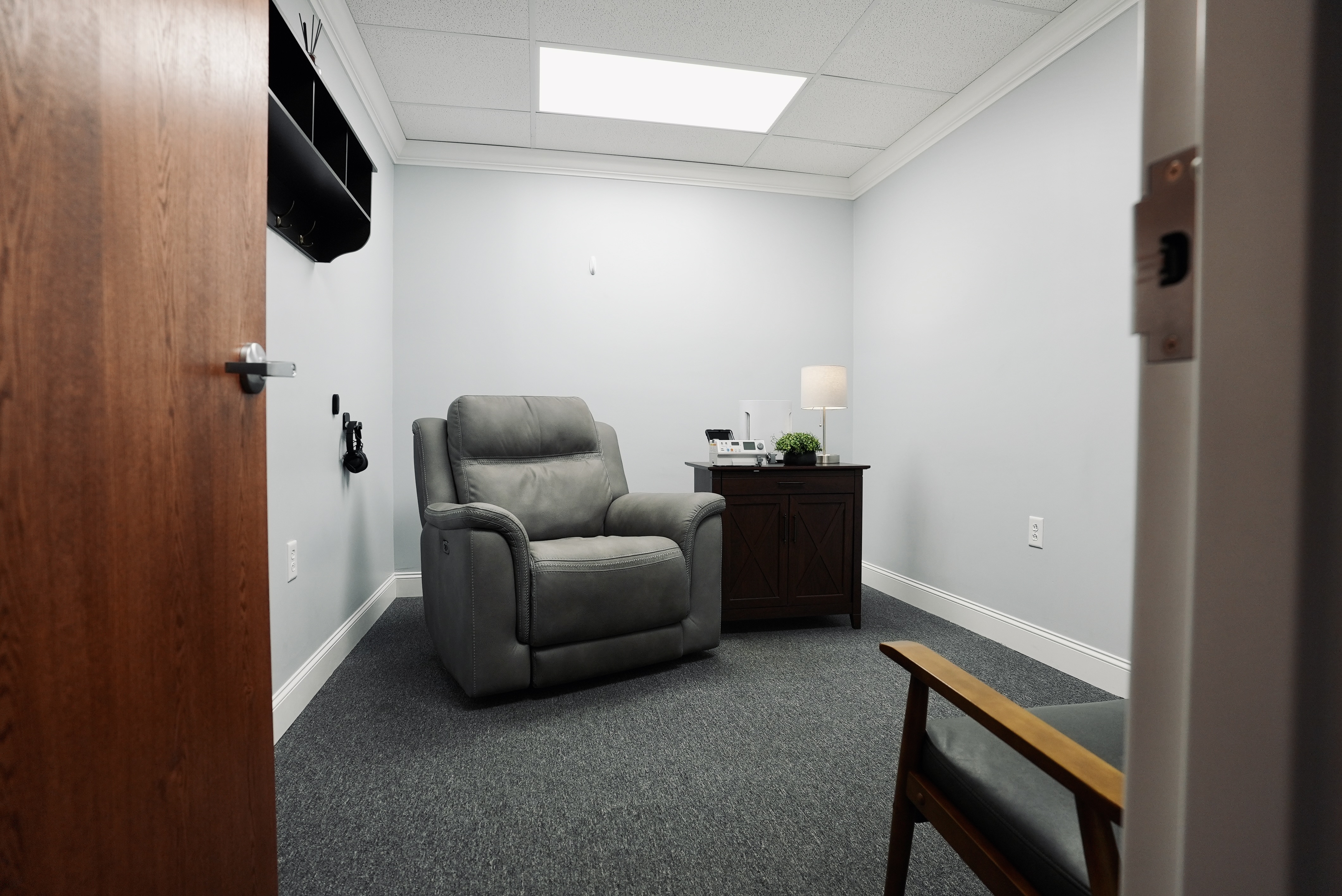
You’ll settle into a private treatment room designed to be calm and quiet — dim light, comfortable recliner, minimal stimulation. Your CRNA starts the infusion and monitors you continuously. Most patients describe a dream-like, deeply restful state — dissociative, not psychedelic. Afterward you’ll rest briefly before your driver takes you home; plan to take the rest of the day off.
Healing happens in calm places. Our treatment rooms are built on that principle.
Step One
The process begins with a no-cost consultation. One of our qualified medical providers sits down with you to determine whether you are a good fit for therapy, or whether you have any contraindications that would put you at risk. Alongside your mental and physical health history, your provider explains how the infusion process works — and you have as much time as you need to ask questions and raise concerns.
You are welcome to bring a friend or family member, though it is not required. During treatment you may feel the need to talk things through, and it helps if your support system understands how neurotherapies work and why.
MSKIT® requires significant patient preparation and education. We believe every patient deserves a fair understanding of how infusion therapy works and accurate expectations for physiologic improvement — which is why you leave your consultation with our detailed treatment guides.
Step Two
If you are a candidate, our Care Team collaborates with you on a personalized plan. Promoting the right environment before, during, and after treatment is critical to reaching your goals. A few things we work through together:
When you feel prepared to begin, our Patient Care Coordinator handles logistics with you — paperwork, payment, drivers, and schedules all sorted before Stabilization starts.
Your care team can include counselors, general physicians, psychiatrists, physical therapists for pain, and our anesthesia team. See treatment pricing and payment options.
Step Three
Stabilization refers to your initial series of infusions. Every infusion is delivered by a Certified Registered Nurse Anesthetist in a private treatment room with continuous vital-sign monitoring.
Six infusions over three weeks. Plan about an hour and a half door to door for a standard mood infusion appointment.
Four infusions over two weeks. These infusions run longer — ask your provider about the length of your pain-focused sessions.
While your experience in the chair does not affect the outcome, our goal is to make your time there as comfortable as possible. We provide a reusable eye mask, water bottle, and headphones with music.
Stabilization is only the beginning. The work you do outside our treatment room — during and after this phase — is what carries you toward the long-term goal of self-maintenance.
Step Four
The rapid improvements seen with infusion therapy are only the halfway mark. Custom maintenance plans and booster infusions as needed are how rapid relief becomes sustained progress.
Our Post-Stabilization Success Plan meeting is personalized to your goals. It is designed to harness the neuroplastic changes from Stabilization — outlining next steps, optional boosters, educational resources, and connections to neurotherapy-educated providers.
Boosters are a safety net that help maintain plasticity while you optimize coping skills, environment, and medications. Most patients receive their first booster roughly 4 to 6 weeks after Stabilization, though frequency and timing are tailored to your response. The need for regular treatment diminishes as your practices and coping skills improve.
Infusion therapy enhances how your brain communicates, which lets you maximize the gains you make outside the treatment room. Psychotherapy — building coping skills, working through past trauma, optimizing daily habits — is markedly more effective after completing our process. Patients treated for chronic pain may also need physical therapy to rebuild muscle and flexibility.
Good mental and physical health is a process to achieve and a lifetime of practice. Improvement is incremental, not always linear, and comes from continuous effort and self-prioritization.
Common Questions
Plan about an hour and a half door to door for a standard mood infusion. Pain-focused infusions run longer — ask your provider about the length of yours. Your appointment includes time to recover in the chair, so there is no need to rush out.
The mood and mood/pain hybrid protocols consist of six infusions over three weeks. The acute pain protocol typically calls for four infusions over two weeks.
Yes — arranging who will drive you to and from your infusions is part of building your treatment plan. Ketamine is active in your system for only 2 to 4 hours; beyond that you judge your own limits, and you will be ready to resume normal activities the next day.
You can choose to have a trusted comfort person remain with you. If you do, it is important they stay for the entire treatment, sit quietly, avoid conversation, take no photos or video, and only hold your hand if you ask.
Being well hydrated and well nourished helps your provider start your IV more easily and aids recovery — but food and liquids should be discontinued two hours prior to treatment.
No. Clinical benefit does not depend on feeling dissociated or having a hallucinogenic-type experience. The science supports the therapeutic effect being linked to what happens in the brain 24 to 48 hours after the infusion.
Some patients notice subtle shifts within hours; others feel meaningful change gradually through the Stabilization Phase and beyond. There is no standardized timeline, as individual responses naturally differ.
Ketamine has been used safely in medicine since the 1970s and, unlike many anesthetics, does not suppress breathing or heart function. Here it is delivered intravenously at low, controlled doses by a Certified Registered Nurse Anesthetist, in a private room with continuous vital-sign monitoring and dosing individualized to you.
Watch Before Your Visit
What to do after completing the Stabilization Phase of Minimally Stimulated Ketamine Infusion Therapy — using the neuroplastic window well.
Tell us a little about what you’re facing. A provider — not a salesperson — will reach out within one business day.
(423) 228-0579Prefer to visit first? Take the Google office tour · 7405 Shallowford Rd, Suite 240, Chattanooga, TN
Free & confidential
A provider — not a salesperson — will reach out within one business day.
Prefer to talk? (423) 228-0579