1. Consultation
A provider confirms TMS fits your history — and our TMS Director verifies your insurance coverage before anything begins.
From brain mapping to your last session — here’s exactly what to expect.
Step by Step
“Adopt the pace of nature: her secret is patience.”
— Ralph Waldo Emerson
Good to Know
Your First Visit
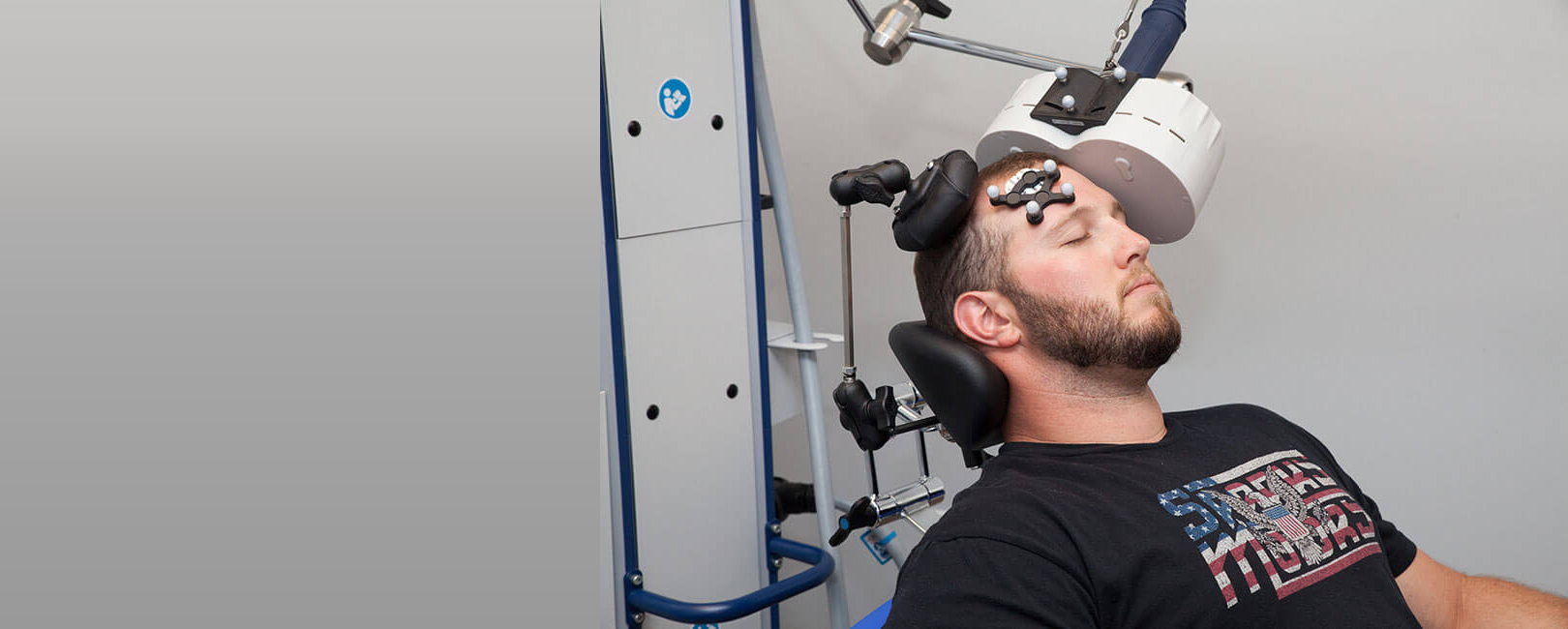
Your first visit is called the mapping. Mapping is a term for locating the exact area of the brain to be treated. For depression, that area is the left dorsolateral prefrontal cortex — just above the left eyebrow.
During the mapping visit we determine your motor threshold: the amount of energy required to invoke a stimulus. That number is specific to you, and it is what makes every session afterward precise rather than approximate. Once mapping is complete, you receive your first treatment the same visit.
We use the most advanced FDA-approved rTMS system with neuronavigation technology, so coil placement is confirmed at every session. Your daily treatments are administered by an rTMS Therapy Certified Technician.
Plan for about 60 minutes on your mapping visit. Classic rTMS sessions after that typically run about 20 minutes.
Choose Your Path
Selecting the TMS path that fits your life is essential to success — the right protocol is the one you can actually complete. All three are available here, and your provider will help you choose during your consultation.
One treatment per day, Monday to Friday, for six weeks, then a three-week wean — 36 sessions total.
An accelerated five-day protocol developed by the Stanford Department of Psychiatry: 10 sessions per day for five consecutive days, 50 sessions total. We are the region’s only provider.
A one-day protocol developed by AMPA. It begins with plasticity priming, followed by 20 iTBS sessions across 9.5 hours — one every 30 minutes.
Why Ours Is Different
At Scenic City Neurotherapy, both Classic rTMS and iTBS (SNT) have three ketamine boosters built into the treatment regimen — usually at the beginning, middle, and end of your plan, scheduled separately from your TMS sessions.
The purpose is global optimization: pairing targeted stimulation with the neuroplastic window ketamine opens produces a more comprehensive and longer-lasting remission of symptoms than either therapy alone. TMS rewires a specific circuit; ketamine improves how the whole brain communicates while that rewiring happens.
Patients report 90% or greater remission of depressive symptoms when completing TMS using either the SNT or ONE-D approaches.
After Your Sessions
You and your provider both have access to the Osmind app to track your progress throughout treatment, and every session begins with time to debrief, ask questions, and adjust your care as needed.
Our Post-Stabilization Success Plan outlines what comes next — optional booster sessions, educational resources, and connections to neurotherapy-educated providers in your area. Once stabilization is complete, you work with your prescriber to optimize your medication plan; many patients reduce their need for daily medications.
Psychotherapy goes further after neurotherapy than it did before. The work you do outside our treatment room is what turns a good response into lasting remission.
Common Questions
Your first session — the mapping visit — lasts around 60 minutes, because we take the time to confirm optimal coil placement and your comfort. For Classic rTMS, sessions after that typically last about 20 minutes.
Classic rTMS is one treatment per day, Monday through Friday, for six weeks, followed by a three-week wean — 36 sessions in total. The iTBS (SNT) protocol delivers 10 sessions per day for five consecutive days, totaling 50 sessions. ONE-D delivers 20 iTBS sessions in a single day.
Yes. TMS requires no sedation and no downtime, so you can drive yourself to and from every session and carry on normally for the rest of the day.
Most people feel a tapping sensation on the scalp. There is no anesthesia and no sedation involved.
Transcranial Magnetic Stimulation is insurance-reimbursable, and we help patients navigate that process. The SNT Protocol is not yet covered by insurance, though we have kept it among the most affordable TMS options in the country. Veterans need only a VA referral — we are in network with Veterans Affairs.
No. Medications are discussed thoroughly during your consultation and taken into account when we build your treatment plan, and any adjustment must be made under the guidance of your prescriber. During the stabilization phase we ask patients not to change medications or lifestyle. After stabilization, you work with your prescriber to optimize your plan — and many patients reduce their need for daily medications.
Dress comfortably; the room can be cool, and we provide blankets if you would like one. You can eat and drink before and after your session but not during it, and you should use the bathroom beforehand. Music and phones are not allowed because of metal restrictions, but our staff stays with you throughout.
Watch Before Your Visit
What you need to know before starting Transcranial Magnetic Stimulation therapy at Scenic City Neurotherapy.
Tell us a little about what you’re facing. A provider — not a salesperson — will reach out within one business day.
(423) 228-0579Prefer to visit first? Take the Google office tour · 7405 Shallowford Rd, Suite 240, Chattanooga, TN
Free & confidential
A provider — not a salesperson — will reach out within one business day.
Prefer to talk? (423) 228-0579