
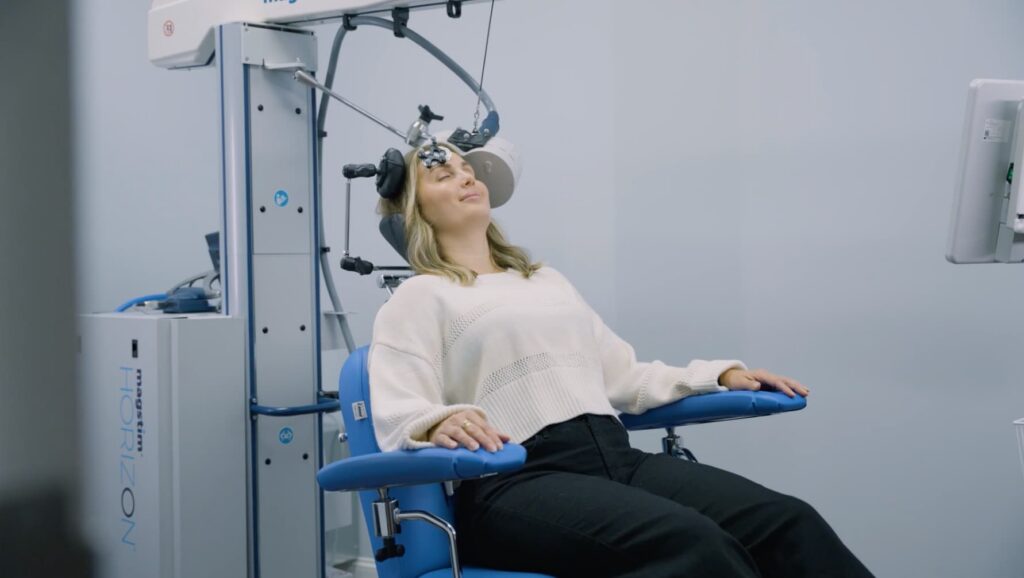
Accelerated TMS is a way of delivering transcranial magnetic stimulation (TMS) in a much shorter window than the traditional six week schedule, with several sessions in one day. For people who cannot step away from daily life for weeks of appointments, that schedule can change which options feel realistic.
This guide explains how accelerated TMS works, how the SNT and ONE-D protocols differ, and what a visit looks like at Scenic City Neurotherapy in Chattanooga. It is written to educate, not to promise results.
What Is TMS, and What Makes It Accelerated?
TMS is a noninvasive, drug free treatment that uses magnetic pulses to stimulate a targeted area of the brain. It has been researched for more than 30 years, and it received FDA clearance in 2008 for adults with major depression who did not find relief from medications.
Classic TMS is delivered once a day, Monday through Friday, for six weeks, followed by a three week wean. That adds up to 36 sessions. Accelerated TMS uses the same kind of stimulation but delivers multiple sessions per day, so the full course fits into days instead of weeks.
Which schedule fits best depends on the person, which is why the protocol is chosen together during a consultation.
How Every TMS Course Begins: Brain Mapping
Every TMS course at Scenic City Neurotherapy starts with a mapping visit. Using 3D mapping, our team locates the exact area of the brain to be treated and measures a number called the motor threshold. That number is specific to each person, and it is what makes each session precise. We use neuronavigation technology so coil placement is confirmed every time.
Plan on about 60 minutes for the mapping visit. Treatment begins the same day once mapping is complete.
Sessions are done awake, and most people feel a light tapping on the scalp. No sedation is involved, so people can drive themselves to and from every session. The most common side effects are mild, brief scalp sensitivity or a light headache.
The SNT Protocol: Accelerated TMS Over Five Days
SNT is an accelerated protocol developed by the Stanford Department of Psychiatry. It uses a form of TMS called intermittent theta burst stimulation (iTBS), with 10 sessions per day for five days in a row. That totals 50 sessions.
A private room and kitchen access are available between sessions. Because the schedule fills a full week, it tends to suit people who can take that time away from work. Three ketamine boosters are also built into the SNT plan and are scheduled separately from the TMS sessions.
The ONE-D Protocol: Accelerated TMS in One Day

ONE-D is a one day protocol developed by AMPA. It begins with a preparation step called plasticity priming, followed by 20 iTBS sessions across 9.5 hours, with one session every 30 minutes.
The whole course happens in a single day, which can be a practical fit for people traveling from out of town. Our Out of Town Patient Guide covers where to stay and what to plan for. You can also read more on our ONE-D protocol page.
How Classic TMS, SNT, and ONE-D Compare
| Classic rTMS | SNT (iTBS) | ONE-D | |
|---|---|---|---|
| Schedule | One session a day, Monday to Friday, for six weeks, then a three week wean | 10 sessions a day for five days | 20 sessions in one day |
| Total sessions | 36 | 50 | 20 |
| Session length | About 20 minutes | iTBS sessions are shorter | One every 30 minutes across 9.5 hours |
| Time away from work | Fits around most work schedules | A full week | One day |
| Insurance | Reimbursable | Not yet covered | Ask our team |
What to Expect on Treatment Day
A little preparation makes the day easier. Our team suggests:
- Dress comfortably. The room can be cool, and we provide blankets.
- Eat and drink before and after your session, but not during.
- Use the bathroom before treatment.
- Leave phones and music out of the room. Metal restrictions apply near the equipment.
Our staff stays with you throughout. You and your provider can both track progress through the Osmind app, and each session starts with time to ask questions and adjust your plan. For more detail, see our post on how to prepare for your first TMS session and our TMS process page.
Questions to Bring to a Consultation
A consultation is a chance to talk through what fits. Some questions worth bringing:
- Which protocol fits my schedule and history?
- How would TMS fit with my current medications and therapy?
- What does insurance cover, and what costs apply? You can review our TMS pricing page in advance.
- What does the full plan look like, from mapping through follow up?
- If I am traveling, what should I plan for?
Frequently Asked Questions About Accelerated TMS
What is accelerated TMS? Accelerated TMS delivers multiple TMS sessions per day, so a full course is completed in days instead of the six weeks used for classic TMS. At Scenic City Neurotherapy, the accelerated options are the five day SNT protocol and the one day ONE-D protocol.
Does TMS hurt? Most people feel a tapping sensation on the scalp. There is no anesthesia and no sedation. Mild scalp sensitivity or a light headache are the most common side effects.
Do I need to stop my medications before TMS? No. Medications are reviewed during the consultation and built into the treatment plan. Any adjustment should be made with your prescriber, and we ask patients not to change medications or lifestyle during the stabilization phase.
Is accelerated TMS covered by insurance? Classic TMS is insurance reimbursable, and our team helps patients navigate that process. The SNT protocol is not yet covered by insurance. Veterans need a VA referral, since we are a VA Community Care Network provider.
Where can I find accelerated TMS in Chattanooga? Scenic City Neurotherapy offers both the SNT and ONE-D accelerated protocols at our clinic on Shallowford Road in Chattanooga. We also serve nearby communities, including Cleveland, Hixson, Ooltewah, Knoxville, Dalton, Ringgold, and Birmingham.
Ready to explore your options? Learn more about TMS therapy at Scenic City Neurotherapy or request a consultation. A provider will reach out within one business day. There is no cost and no obligation.
Follow us! @sceniccityneuro